
Saskatchewan Landing Provincial Park: Where the Prairie Meets the River


Saskatchewan is often introduced through its big icons: golden wheat fields, endless skies and that sense of space that humbles even the most well-travelled visitor. Yet some of the province's most rewarding corners lie quietly off the beaten path — places where the prairie suddenly opens up, drops away, and reveals a river valley that you would never have guessed was there. Saskatchewan Landing Provincial Park is one of those places.

About 50 kilometres north of Swift Current, Highway 4 dips down into the broad valley of the South Saskatchewan River, where it meets the western tip of Lake Diefenbaker. Established as a provincial park in 1973, Saskatchewan Landing covers some 5,735 hectares of rolling grassland, river bluffs, sandy beaches and quiet coulees. For travellers crossing the prairies, it is a moment of surprise — a secret pocket of green and blue tucked into the wide horizon.
Credit: Tourism Saskatchewan Credit: Dave Reede Photography
The park's name carries its history. This stretch of the South Saskatchewan River was once an important crossing on the Swift Current–Battleford Trail, used by Métis river travellers, settlers and Red River carts on their way north. The handsome stone Goodwin House, built in 1897 by early settler Frank Goodwin, still stands today and serves as the park's visitor information centre. Traces of those earlier journeys are still etched into the land — a quiet reminder that the prairie is anything but empty.
Three interpretive trails wind through the park's varied landscapes, each with its own character. Prairie Vista climbs gently into the hills and shows how a small stream can nourish a whole ribbon of green in the middle of the dry grassland. Ridges and Ravines reveals the geological story of the South Saskatchewan River Valley, with rib-like ridges and a glacial rock garden along the way. The Rings, Ruts and Remnants Trail brings the park's history to life: walkers move quite literally in the footsteps of those who once crossed this land, past tipi rings, stone cairns and the ruts of long-vanished wagons.
Credit: Paul Austring Credit: Paul Austring Credit: Tourism Saskatchewan
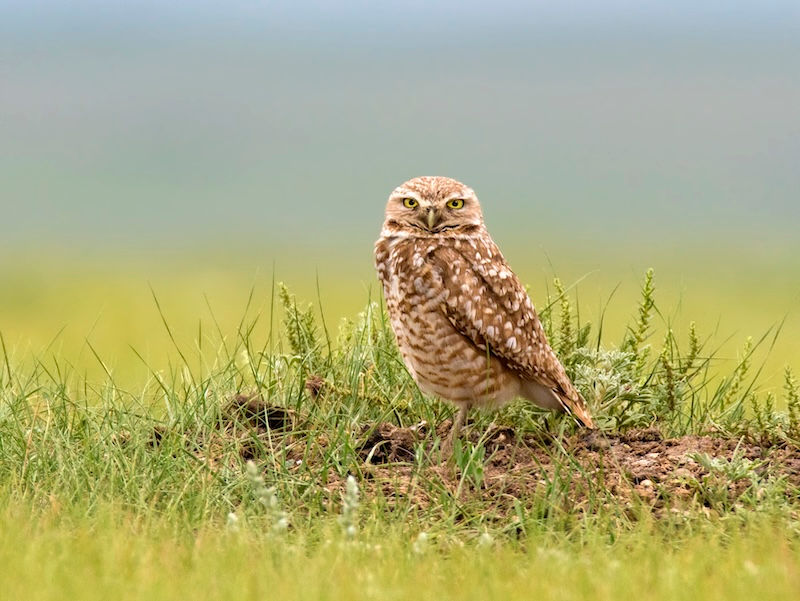
The park sits in semi-arid grassland country, and its wildlife reflects that — ferruginous hawks, prairie falcons, burrowing owls and golden eagles are among the rare species that make Saskatchewan Landing a quiet hot spot for birdwatchers. With over 215 bird species recorded in the area, binoculars are well worth packing.
Down at Lake Diefenbaker, the day takes on a slower rhythm. The northwestern beach stretches out under cottonwood trees, perfect for an afternoon swim or a picnic in the shade. Anglers cast for northern pike, walleye and rainbow trout, while paddlers, windsurfers and sailors make the most of the open water. For those who prefer fairways to fishing rods, the Sask Landing Golf Resort offers an 18-hole course with views of prairie grassland, the lake and the surrounding hills — a rare combination, and one of the few golf courses set inside a Canadian provincial park.
Credit: Paul Austring Credit: Paul Austring Credit: Tourism Saskatchewan Credit: Tourism Saskatchewan Credit: Andrew Penner
What makes a stay at Saskatchewan Landing particularly compelling is the chance to swap the tent peg for a touch of comfort. On a fully treed, lakefront site of around 5.6 acres, Glamping Resorts operates a small camp that opens from the May long weekend through to September. Guests can choose between a Family Canvas Cabin or a Couples Canvas Cabin — generous canvas tents furnished to rival a hotel room, yet still wrapped in the sounds of the prairie. Days end on a deck looking out over Lake Diefenbaker; nights bring something even rarer. With almost no light pollution for miles around, the Milky Way arcs clearly overhead, and the prairie settles into deep silence.
Credit: Tourism Saskatchewan Credit: Tourism Saskatchewan Credit: Tourism Saskatchewan Credit: Tourism Saskatchewan
Saskatchewan Landing rewards travellers who slow down. It is a park of small discoveries rather than big icons — a beach hidden behind a bend in the highway, a hawk circling over an empty ridge, a glamping tent glowing softly in the dusk. For visitors keen to look beyond the postcard images of Canada, this quiet corner of Saskatchewan offers a different kind of beauty: wide, weathered, and deeply alive.
More information can be found with Tourism Saskatchewan, SaskParks and Glamping Resorts.


Comments