
Comeback of the Giants: Whooping Cranes Touch Down on the Saskatchewan Prairie

Updated: Sep 9

You hear them long before you see them. A piercing, trumpet-bright call rolls across the wide-open fields of Saskatchewan, and only then do the white silhouettes appear, stitched against an endless prairie sky. It is precisely that call — that whoop — which gave the Whooping Crane its name. Standing almost 1.5 metres tall, these are the tallest birds in North America and among the rarest creatures on the entire continent. And their most important resting place on the long flight south? Saskatchewan, in the very heart of Canada.
A Comeback on Quiet Wings
The story of the Whooping Crane is, at heart, a story of survival by the narrowest of margins. A century ago, hunting and habitat loss had pushed the species to the very edge — at one point, just 15 birds remained. Today, more than 500 whoopers grace the skies again, and the breeding grounds in Wood Buffalo National Park, straddling the border between Alberta and the Northwest Territories, are watched over with quiet care, year after year. Among ornithologists, the slow return of these elegant giants counts as one of the great success stories of wildlife conservation worldwide.
Credit: Nick Saunders Credit: John Criton Credit: John Triton
Why Saskatchewan?
On their roughly 4,000-kilometre journey from the northern breeding grounds to the Aransas National Wildlife Refuge on the Texas Gulf coast, Whooping Cranes follow a remarkably narrow flyway — and few landscapes are better suited for refuelling, resting and roosting than the damp sloughs and stubble fields of Saskatchewan. East and north of Saskatoon, a mosaic of saline lakes, freshwater ponds, wetlands and grain fields offers everything the birds could wish for on their long voyage. Quiet water, open sightlines, fields rich in spilled grain — pure prairie hospitality.
The Best Time for an Encounter
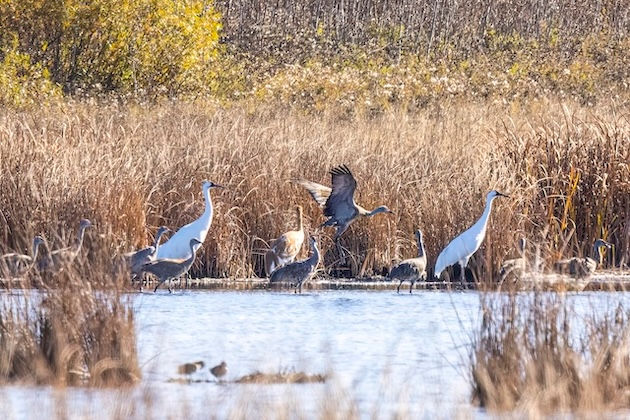
Anyone hoping to see Whooping Cranes in the wild should mark the calendar between mid-September and mid-October. Within this window, the birds pause in Saskatchewan on their way south, often in the company of tens of thousands of snow geese and the considerably more common, brownish sandhill cranes. Among them, the slender white whoopers stand out at once — small points of light scattered across the stubble. Favoured resting grounds lie around Saskatoon, in the fields near Marcelin, and at the Last Mountain Lake National Wildlife Area, North America’s oldest bird sanctuary, established as long ago as 1887. The exact spots shift from year to year, depending on which fields have just been harvested. The cranes follow the grain — and the guides follow the cranes.
Marcelin - Credit: Neil Zeller Photography Credit: Chris Hendrickson Photography Credit: Chris Hendrickson Photography
Guided Tours to the Rare Visitors
So that visitors do not have to leave these fleeting encounters to chance, experienced local guides have made a true speciality of the Whooping Crane. Among the most seasoned of them is Stan Shadick from Saskatoon, who has been leading Whooping Crane tours for decades — with all proceeds going to the wildlife conservation charity Living Sky Wildlife Rehabilitation. In autumn 2025, observers reported a record-breaking 196 Whooping Cranes in a single day, according to tour organisers. Numbers like that are rare indeed — but smaller family groups can be every bit as moving, especially when a pair of adults moves slowly through the golden prairie light with the rust-coloured colt of the year at their side. Travellers with more time often pair the birdwatching with a side trip to nearby Prince Albert National Park, where the boreal forest glows in the warm tones of a Canadian autumn.

Whooping Cranes, snow geese, the wide-open prairie — and over it all, Saskatchewan's golden autumn. A nature experience off the beaten path that rewards patience and curiosity in equal measure, and that quietly tells one of the most moving conservation stories in North America.
Further information on Saskatchewan and the Whooping Cranes can be found with Tourism Saskatchewan.


Comments